ATTITUDE OF COMPASSION
1. The Decalogue is the face of God’s justice.
The Beatitudes are the face of God’s love. On the one hand, divine justice is
synonymous with altitude—the ascent of man on the narrow and hard path that leads to life. [cf. Mt 7:13-14] The Holy
One of Israel [Isa 10:20] calls his human creation to a holy way of
life: “For I am the Lord your God;
consecrate yourselves therefore, and be holy, for I am holy.” [Lev 11:44]
2. On the other hand, divine love is
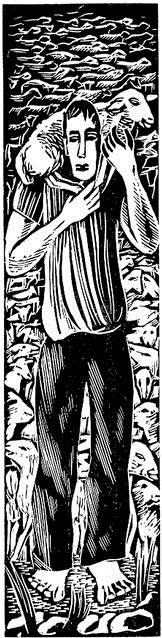
correspondent to an disposition or attitude to compassion, the length and breadth which our gracious God will traverse to rescue fallen man. Jesus’ parable of the lost sheep clearly is a story of
beatitude:
WHAT DO you think? If a
man has a hundred sheep, and one of them has gone astray, does he not leave the
ninety-nine on the mountains and go in search of the one that went astray?
AND IF he finds it,
truly, I say to you, he rejoices over it more than over the ninety-nine that
never went astray. So it is not the will of my Father who is in heaven that one
of these little ones should perish. [Mt
18:12-14]
 GEOGRAPHY OF DISTRESS
3. The lamb, having gone astray, is incapable of
scaling heights and attaining expectations. Weak and helpless apart from the
shepherd’s vigilant care, it falls into perilous circumstances. The shepherd
leaves his flock on the mountains—emblematic of loftiness and stature, struggle
and accomplishment—and searches, not in obvious or comfortable places but in
the geography of distress and darkness.
4. When searching for the lost sheep, the shepherd
looks beyond pasture to wilderness. Hills give way to crevices. A
single sheep, alone and disoriented, attracts the predator. Many of us remember
the familiar illustrations of the parable of the lost sheep—the shepherd
leaning far down into a dark ravine of briars, uses the crook of his staff to
grasp the lamb.
SIN OF POWERFUL MEN
5. The human soul is a vast and uncharted realm.
Many persons refuse to explore the soul that God has given them. They may think
it irrelevant to the attractions of a material world or that its formidable
topography is benign and impervious to injury. How easy it is to fall out of
green pastures into a terrifying wilderness! Abandon the shepherd and embrace
the sin! With one lesser wrong decision piling up on another, the human person is
impelled toward evil consequences which he neither grasps or intended from the
beginning.
6. Not consciously choosing evil for its own
sake, man nevertheless mystifyingly chooses to do the wrong in the mistaken
hope that good will come from it. He hopes that the possibility of proximate
good will absolve him—not his soul, for he is ignorant of this, but his disturbing
memories. Ignorant of his soul, he
possesses neither conscious awareness of it or the vocabulary to speak about
it. He is deaf to the groanings of his battered, neglected conscience.
7. Powerful men scorn the sovereignty of God,
hence giving to the innocent and helpless what they are due in God’s eyes.
Hence, the innocent person may despair of God’s deliverance, which is to say,
his mercy. The sin of powerful men therefore is great, for added to their
provocations against God’s mercy is an egregious contempt for the divine image and
likeness intrinsic in the human personhood of those whom they exploit: “Many shepherds have destroyed my vineyard,
they have trampled down my portion, they have made my pleasant portion a
desolate wilderness.” [Jer 10:10]